
Identify Whitley County Property Owners
Figuring out who owns a Whitley County property takes more than one lookup. Start with the address, but let the parcel number and the deed finish the job. The county assessment record names the owner tied to each parcel on the tax roll. The recorded deed shows the legal transfer behind it. Those two records can carry different dates, spellings, or entity forms. A careful Whitley County property search connects the address. It links the parcel identifier and deed description. Only then should you treat any person or company as the owner of record. That step keeps a mailing address distinct from an occupant. A holder of a recorded interest stays separate too.
- Search the official Whitley PVA route by address and save the returned parcel or account identifier.
- Read the generic qPublic
Ownershipresult as an assessment lead, then note the result date. - Find the newest matching deed through the Whitley County Clerk and compare its grantee and legal description.
- For an entity name, check the Kentucky Secretary of State record and any deed signatory or estate file.
This path answers an ownership question with named sources rather than an address guess. A common name needs a second identifier. A split tract needs its acreage and legal calls checked against the deed. When no online image is available, the clerk can supply more information. Or request a copy at 606-549-6002, option 2.
Trace a Whitley County Address
An address is the easiest clue. But the bridge that holds up has three parts: address, parcel identifier, and recorded legal description. The official Whitley PVA entry page offers search routes by name, address, and parcel number. Field labels and the parcel-number format on a live Whitley card may differ from generic qPublic labels. So read the local result rather than assuming a standard layout.
Try the street number with and without a directional prefix. Then try road and highway variants, and the mailing city on its own. Once a parcel appears, save its identifier and compare its area, city, and address. Carry that key into the clerk search. The legal description may be lot and block, acreage, survey calls, or a source-deed reference. It is the best continuity test when a street name has changed.
Read Whitley County Ownership Results
The generic qPublic result inventory uses fields such as Parcel, Address, and Ownership. Other fields include City, Area, and ASV. That inventory comes from the official vendor. It is not a sample Whitley County property card. Treat Ownership as the field to seek. Then verify the labels on the actual county result. The Whitley PVA entry page shows the official path into the assessment search.
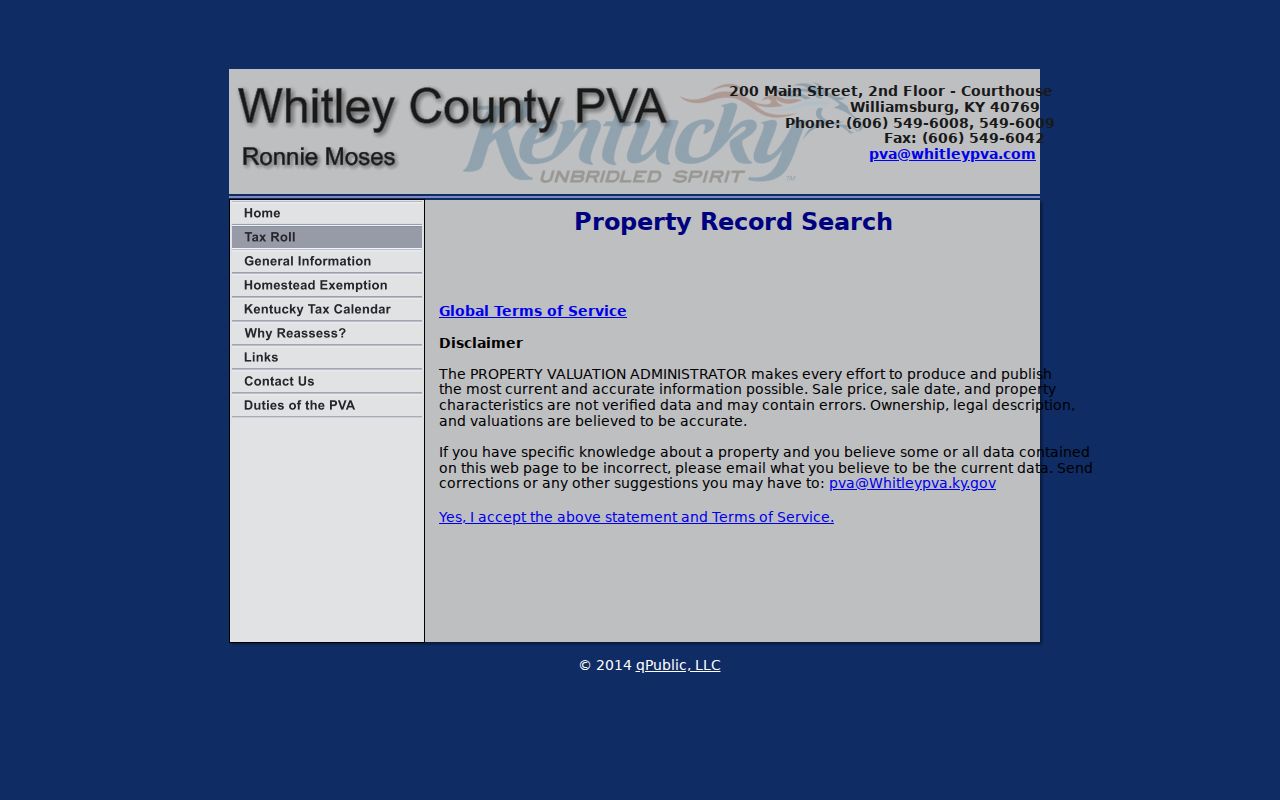
This entry marks where owner discovery begins, while the deed remains the proof step for the transfer itself.
Compare Whitley County Owner Sources
No single screen settles every Whitley County owner question. Each source answers a different part. The assessment record ties a name to a tax-roll parcel, the deed records a conveyance, and an entity profile helps interpret an LLC name. A map can orient the parcel, though the county offers no public GIS viewer of its own.
| Source | Owner Info It Gives | Access |
|---|---|---|
| Whitley PVA / qPublic | Assessment ownership lead and parcel identity | Public search route; live card fields can change |
| Whitley County Clerk | Grantee, grantor, date, and legal description | eCCLIX or direct office request |
| Kentucky Secretary of State | Business entity profile and registered-agent lead | Public business entity search |
| Recorded plat or deed map reference | Lot, tract, and subdivision identity | Clerk record; statewide GIS only for orientation |
Never read the name on a tax or assessment record as an occupant. It may belong to a person, trust, estate, or business with a different mailing address. The deed grantee is stronger evidence. It shows the recorded transfer. Even so, a deed search is not a full title examination.
Date Whitley County Owner Evidence
Kentucky assesses real property as of January 1. A sale recorded after that date can leave the earlier name on the current tax bill. Whitley County has not published a fixed number of days for the PVA roll to reflect a deed, so the safe response is to date both results instead of promising a routine lag.
Write down the PVA access date, the displayed ownership term, and the deed recording date. If they differ, check for a recent transfer, correction deed, trust or estate wording, or an assessment name that has not synchronized. This date discipline turns a vague who owns result into an evidence trail another reader can repeat.
Identify Whitley County Entity Owners
An LLC, trust, or estate name may be the actual grantee, not a mask to swap for a person. Search the exact entity wording shown on the deed. The Kentucky Secretary of State Business Entity Search accepts a selected criterion, search text, and an active-entities-only choice. It can yield an entity and registered-agent lead. Filings and certificates remain separate records.
- Owner of record
- The party identified by a stated public source as holding the assessed or recorded interest.
- Vesting
- The deed language describing how the grantee takes title or an interest.
- Grantee
- The person or entity receiving the interest in a deed.
- Situs address
- The property's location, which can differ from an owner's mailing address.
For an estate, a will, affidavit of descent, probate file, or court order may explain the transfer. For a trust, the deed and its signatory often beat an assessment abbreviation. Never merge similar entity names without a matching legal description.
Monitor Whitley County Owner Filings
DOC Alert works as a watchtower, not a search engine. The Whitley registration form asks whether the enrolled name belongs to a business. It can also be a trust. It then collects the county, the name, a suffix, an email, and confirmations. Once enrolled, the service sends an alert. A later deed or mortgage filing under that name in the property records index triggers it.
That scope is narrow by design. It never reconstructs an existing record. It cannot tell you who owns a property in Whitley County today. It does not reach historic deeds at all. Treat it as a step that follows the clerk and PVA check. It is not a substitute for either. An alert system watches new index activity. An ownership search rebuilds the record that already exists. The two answer different questions, and confusing them leads to false confidence.
The county clerk accepts electronic recording through several vendors. Those are submission channels for filers, though. They are not public owner searches. A successful alert enrollment proves nothing about the current owner of record. Only a retrieved and matched recorded instrument can do that.
Limit a Whitley County Owner Lookup
Every public lookup has edges. A result cannot prove who lives at an address. It cannot settle every title interest or fix an exact boundary between parcels. A lookup may also lag reality. A just-recorded deed change can take time to appear, and the tax roll carries the January 1 assessment name even after a later sale. Kentucky Safe at Home gives qualifying participants a substitute address with mail forwarding. Its own real-estate guidance notes that land holdings may still remain public in the property records.
Use records with care. Whitley County owner information supports lawful property research and due diligence. It must never be used to stalk, harass, intimidate, or harm a person.
The gap between the assessment name and the newest deed deserves its own careful reading. The Whitley County current owner record guide walks through that present-tense distinction. For ownership further back, the former-owner page follows the parcel chain backward. It works through the deed records step by step.
Corbin and Williamsburg parcels open another avenue. City zoning or permit files can add context about a property's use. Neither city, however, offers a confirmed public permit database searchable by address. Municipal files never replace the county deed. Ask a city clerk or planning office for a named existing file only after the county parcel number has been pinned down.