
Reconstruct Whitley County's Former Owners
Start with a real transfer row. Copy each date exactly. Note whether it is the execution or recording date, since the two can differ. On the latest deed, the grantor is usually the immediate prior owner, the grantee is the party receiving the stated interest, and the book/page or instrument number makes each step reproducible.
| Transfer Date | Grantor to Grantee | Deed Type | Book/Page |
|---|---|---|---|
| Newest located recording | Immediate former owner to current grantee | Copy exact deed label | Copy clerk locator |
| Prior recording | Earlier owner to immediate former owner | Warranty, quitclaim, correction, or other stated type | Copy cited locator |
| Earlier book entry | Repeat backward with matching land | Use the instrument's own label | Preserve book and page |
Treat this as a worksheet pattern, not a sample chain. Not every row exists online. The Whitley County Clerk warns that some deed images never appear on the web. When the index supplies only a locator, request the deed itself. Treat a former-owner link as confirmed only then.
Measure Whitley County Deed Depth
Recorded dates in Whitley County attach to specific record series. They do not attach to deeds as a whole. The clerk lists articles from 1985, wills from 1925, and leases from 1949. Miscellaneous records start in 1960, and encumbrances begin in 1972. None of those is a deed start date. Current deeds flow through the clerk. The eCCLIX public account route reaches the index. A direct request fills the gap whenever an image is missing.
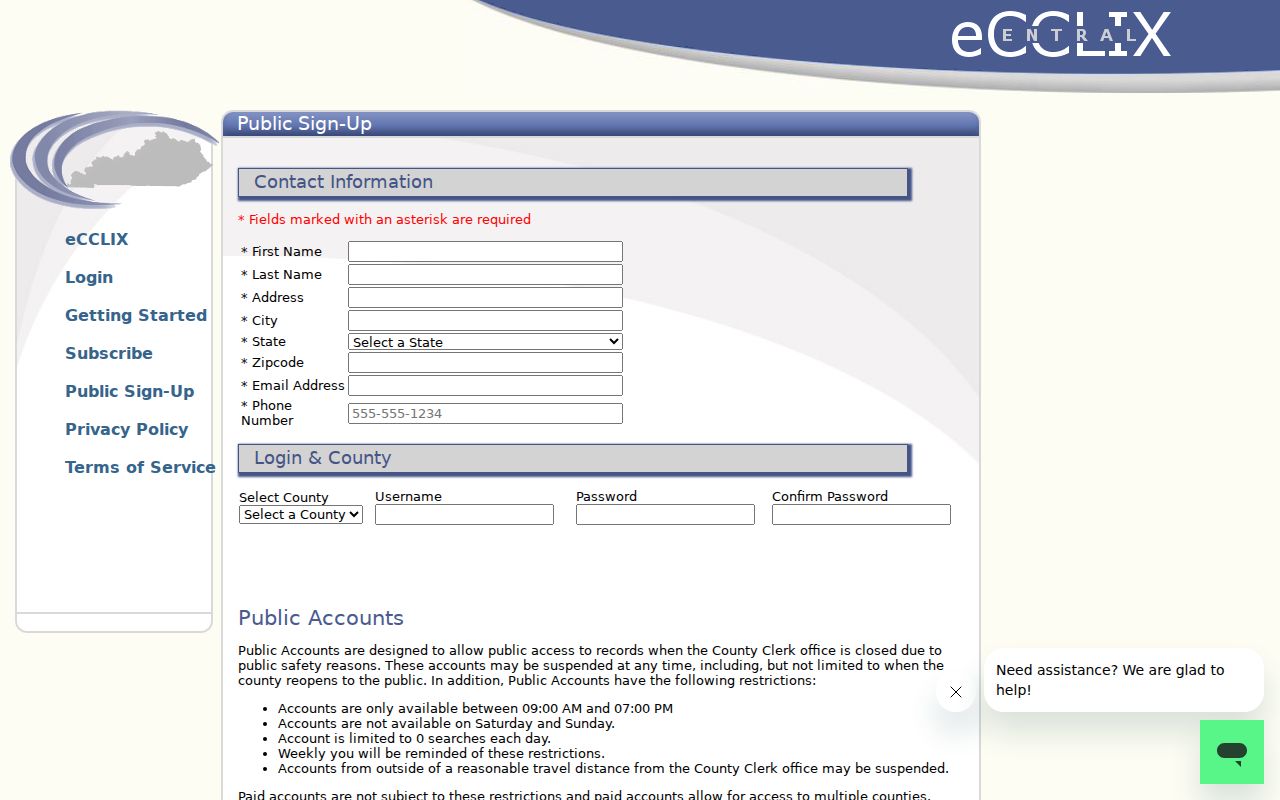
That page shows the access condition only. Actual deed parties still require an index result or a clerk copy.
Step Back Through Whitley County Deeds
Working backward pairs names with the legal description. Names locate candidate records. The description proves each record concerns the same land. A street address can vanish from older volumes, while a lot/block call, acreage figure, creek, road, survey call, adjoining owner, or prior-book reference often survives.
- Find the newest deed in which the current party appears as grantee.
- Copy the grantor, dates, deed type, locator, and full legal description.
- Search that grantor as a grantee to locate the earlier acquisition.
- Repeat while comparing acreage, lot/block, survey calls, and prior references.
- Move to clerk books or KDLA when the online route stops.
- Grantor
- The party conveying the interest stated in an instrument.
- Grantee
- The party receiving that stated interest.
- Chain of title
- The ordered sequence of instruments connected to the same land.
- Reverse index
- An index organized to locate a party on the opposite side of a transfer.
- Quitclaim and warranty
- Different deed forms whose legal effect must be read from the instrument.
A quitclaim can pass an interest for nominal consideration. It never proves the grantor owned more than the deed conveys. A correction deed may fix a name or description without creating a new sale, so label each event precisely.
Repair Whitley County Chain Breaks
A clean sale-to-sale sequence breaks whenever land moves through an estate, trust, court order, foreclosure, parcel split, merger, or correction. Pull the supporting file named in the deed. An affidavit of descent, will, probate order, corporate resolution, or commissioner deed often explains why the next former owner is missing from a simple purchase row. Split or merged tracts need extra care. Compare legal calls and acreage across every related tract before assuming two rows describe one holding. A mortgage release conveys no land. A lis pendens signals litigation but transfers nothing. Recording exact dates and instrument classes keeps these events from masquerading as owners.
Crosswalk Whitley County's Old Names
Historic geography defeats many modern-address searches in Whitley County. Williamsburg was once called Whitley Courthouse. It later became Williamsburgh. Railroad-era Corbin can appear under older local terms. Search those names widely. Include subdivision references, roads, creeks, and adjoining owners, with grantor and grantee spelling variants. Plats tie lots to subdivisions. The clerk lists plat recording but publishes no online plat-book index. Ask for the book/page or instrument number. A planning map may orient the work. Yet it cannot replace a recorded plat or survey.
Request Older Whitley County Owners
When the online trail ends, send a narrow request. Give every name spelling. Add approximate years, the present or old address, legal-description terms, and any known book/page references. Ask for plats, easements, releases, and corrections too. The Whitley County Clerk accepts requests by hand, mail, fax, or email and directs copy questions to 606-549-6002, option 2. KDLA takes deed, probate, tax, and county-record research requests online, by email, or by mail. Turnaround is usually four to six weeks. Base charges run $20 for Kentucky residents and $25 for out-of-state requesters, so verify current terms before sending anything, and check the Whitley County deed records guide for one recent copy.
Audit Whitley County's Prior Owners
Log every step of the audit. Preserve the index, spelling, access date, locator, image status, execution date, recording date, grantor, grantee, and matched legal description. A negative result still has value. Write down the terms and access limits. The miss may point to a variant name, an older book, a missing image, or another county entirely. Never claim a deed does not exist. One empty portal proves only itself. Say instead that no match appeared there under the tested terms, then run the clerk, KDLA, and local library as separate channels. That wording keeps a chain honest across systems and stops prior owners with similar names from being merged into one person.
Reach Whitley County's Earliest Owners
KDLA's official inventory lists Whitley County deed holdings from 1818 through 2016. The county was organized from Knox County in 1818. A deed pointing earlier may actually live in Knox. Ask which predecessor jurisdiction recorded the instrument and which repository holds it today.
No universal online cutoff. The clerk does not publish one deed-index start year. KDLA's holdings range does not mean every page or image is online.
Early owner research in Whitley County rewards persistence. Start at the Whitley Courthouse. Also try the spellings Williamsburgh and Williamsburg, since record keepers used both. Corbin entries pose their own puzzles. A parcel there may sit under Lynn Camp, Cummins, Woodbine, a railroad line, or an older road name instead of a modern address. Newspaper clues help too. Obituaries and estate notices from the library can point toward a former owner or a family connection. But a clue is only a clue until a deed, court order, or archival copy confirms it.
One caution belongs here. The last grantor you can verify in the chain is rarely the true first owner. When a reference reaches back before the county was organized, follow it into the predecessor records rather than stopping at the boundary. Describe past owners only as far back as matched instruments actually support.
The library's newspaper runs add real depth. The Williamsburg Times spans 1891 through 1910, the Corbin Times covers 1919 through 1934 except 1922, and the Whitley Republican and News Journal series carries from June 1934 forward. Within those pages you may find a sale notice, an address variant, or an estate filing. Still, the record proof comes from the deed, the probate file, or the court record itself.