
Start a Whitley County Property Search
The Whitley PVA search is the practical first stop. Use it when an address, owner, or parcel number is already in hand. A typical qPublic result can carry a lot. Fields may include the parcel number, alternate ID, address, ownership, city, area, state, assessed value, reference number, and section-township-range data. Labels on the live card can differ. Read each field as the screen presents it instead of assuming.
A PVA match is only a lead. It is a lead, not a deed, survey, or proof that anyone named occupies the site. Carry the parcel identifier and the exact ownership spelling forward. Add the source date and the legal-description clue. Take it into the clerk, tax, and court systems, where the trail separates a true match from another tract on the same road.
- Search qPublic by address, name, or parcel and save the parcel/account identifier.
- Use the Whitley County Clerk index to locate the newest deed and its prior reference.
- Compare the sheriff tax bill and Kentucky assessment date with the transfer date.
- Use available state map layers only to orient the parcel, then check the deed and plat.
- Request a missing image or certified copy from the office that keeps the record.
Whitley County Records Custodians
Kentucky gives this county no separately titled recorder. The County Clerk records deeds, mortgages, liens, releases, plats, leases, wills, and related instruments. The Property Valuation Administrator (PVA) maintains the assessment roll. The sheriff handles current county tax bills. The clerk also administers delinquent-tax certificates and sales, so each office answers a different question and none replaces the others.
Whitley County PVA
Courthouse, second floor
Williamsburg, KY 40769
Confirm current contact details
Whitley County Sheriff Tax Office
200 Main Street, Suite 1
Williamsburg, KY 40769
Use the current office listing
Deed Index Access for Whitley County Property Records
The clerk's records page lists the computer index categories. Deeds, mortgages, mechanic's liens, orders, fixture filings, wills, leases, plats, and encumbrances all appear there. The linked eCCLIX service may require an account or subscription. Not every indexed document has an online image. Record each index hit with care. Note the party names, instrument type, filing date, and book/page or instrument reference.
When no image exists, call the recording division. The open-records policy permits hand delivery, mail, fax, or email and generally calls for a determination within five working days under Kentucky law. Ask for an existing document, not a custom report.
Note: Current eCCLIX search fields and Whitley image coverage must be confirmed on the live service.
January 1 Shapes Whitley County Property Records
Kentucky assesses real property as of January 1. That date can explain why a tax bill names the person who held the parcel at the start of the year even though a later deed records a sale. The Kentucky property-tax calendar also places the inspection and appeal period before tax bills move through the fall and spring collection cycle.
This timing is a local search clue, not proof of an error. Compare the deed recording date, the grantee, the legal description, and the access date of the PVA card. If the facts still conflict, ask the PVA about its update and obtain the newest recorded instrument from the clerk.
Corbin Geography Changes the Whitley County Property Records Route
Corbin's city limits and mailing geography spill into three counties. A Corbin postal address alone does not tell you whether the parcel sits in Whitley, Knox, or Laurel County. Locate the parcel first. Confirm its county before anything else. Then use that county's deed and assessment systems for the property question. Corbin itself answers zoning, permit, annexation, and code questions.
Williamsburg brings the opposite wrinkle. ZIP 40769 reaches places that may sit outside the city limits even when the mailing address says Williamsburg. A city map or annexation ordinance settles the municipal question, while the Whitley deed and PVA card settle the county one, keeping a valid no-result from being mistaken for a missing record.
Match Whitley County Property Records to the Question
Whitley County property records form a linked evidence set. A deed documents a transfer. A PVA record names the assessed parcel and value. A tax bill tracks collection, and a plat defines the recorded lot. Court and city records add litigation or land-use facts, so pick the record that answers your question and confirm the parcel identity with a second source.
| Record Type | What It Documents | Kept By | Access |
|---|---|---|---|
| Deeds | Recorded ownership transfers and descriptions | County Clerk | Index, office, copy request |
| Mortgages and liens | Recorded claims, releases, and assignments | County Clerk | Index and instrument copy |
| Assessment and tax | Tax-roll owner, value, bill, and delinquency | PVA, sheriff, clerk | qPublic, tax portal, offices |
| Plats and parcels | Lot, block, acreage, and map context | Clerk, PVA, state GIS | Recorded plat and available layers |
| Permits and zoning | Land-use action and work history | Corbin or Williamsburg | Direct city request |
A buyer tracing ownership starts with the deed. Its prior reference walks the chain of title. Assessment and payment questions go instead to the PVA and sheriff, and exact boundaries call for the deed, plat, and often a licensed survey rather than a web map. Clerk mechanics sit with the Whitley County deed records. Billing and appeal timing sit with the county property tax records.
Tax Bills Within Whitley County Property Records
To look up a current tax bill, start with the Whitley County Sheriff's tax page. The page sends bill searches to the Properly service. The live query fields can vary. So have your parcel or account number and the tax year close at hand. Remember that a paid bill, an assessed parcel, and a recorded deed describe three different events. Their names and dates do not always match on the same day.
Delinquent certificates follow a separate process run by the clerk. The current clerk notice governs registration, priority, payment, and sale details for that cycle. Appearing on the list proves none of the things buyers often assume. It does not show vacancy, possession, clean title, or the final outcome. Later clerk instruments and court files decide those questions.
Court Files That Affect Whitley County Property Records
Kentucky CourtNet opens public case information for every county in the state. Search by owner, co-owner, estate, trust, lender, or business name. Then narrow by county and case type. Foreclosure, partition, quiet-title, boundary, probate, and specific-performance cases can all affect land. Even so, a shared name proves nothing. It needs a legal description, lis pendens, deed, or case document to tie the case to a parcel.
For the file itself, contact the Circuit or District Clerk at the Whitley County Judicial Center. Older material may sit in local storage or a records facility. It may sit with KDLA, or nowhere at all under a retention schedule. A case number and locator number will get you much further than a broad name request.
The official Kentucky court-record request page lays out the clerk, locator, archive, and copy-request route.
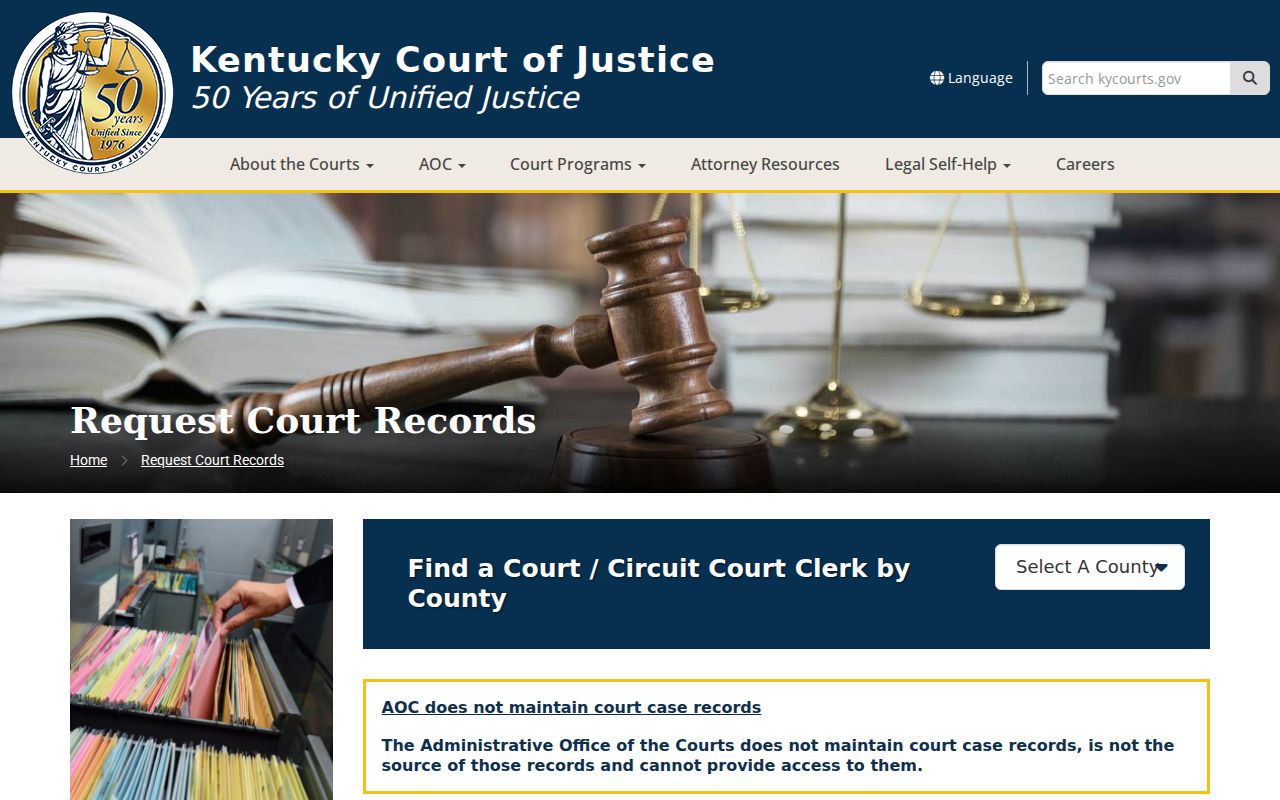
That screen is a request guide rather than a Whitley case result. Use it after CourtNet or the local clerk gives you a county and case number.
Whitley County Property Records Reach the 1818 Era
The Kentucky Department for Libraries and Archives county inventory lists Whitley deed holdings. They run from 1818 through 2016. That span describes archival holdings, not guaranteed online images. Begin with the most recent recorded deed. Chase its prior book and page reference, and repeat the grantor search. When the web trail runs dry, ask the clerk or the KDLA records service for the older deed book or microfilm.
Old identities sometimes surface in the Whitley County Public Library genealogy collection. It holds newspapers, obituaries, local history, oral histories, and funeral-home material. These sources can explain a former name or an old address. Still, they remain leads. A deed, probate instrument, or court record must connect the person to the tract.
Note: Williamsburg records may use Whitley Courthouse, Williamsburgh, or Williamsburg as historic place-name variants.
Parcel Maps Need Whitley County Property Records Verification
Whitley County publishes no current official local parcel viewer. The Kentucky Division of Geographic Information offers statewide GIS resources and county context, but treat a statewide layer as context rather than a verified local ownership map. Rely on it for roads, streams, broad geography, and possible parcel context, and only when the layer names its source and date.
A map line is never the legal boundary. Set the mapped shape beside the deed description, the recorded subdivision plat, the acreage, and the monuments. Where a purchase or dispute turns on the exact line, a licensed survey fills a role no online polygon can.
Whitley DOC Alert Monitoring
The clerk links to DOC Alert, a free service. It sends notice when a deed or mortgage is indexed under a registered personal or business name. Registration needs only a name or business/trust choice plus an email address. After a property search, it makes a sensible fraud-warning step.
An alert blocks no filing, insures no title, and settles no question of validity. A notice may arrive unexpectedly. Preserve it. Inspect the indexed instrument, and contact the Whitley County Clerk. A current deed copy and qualified legal help may be warranted before you act.
Read Whitley Clerk Screens Carefully
The official clerk page opens the route to recording, image access, fraud alerts, and requests. It also shows why the index and the document are not the same thing. The Whitley County Clerk records page displays the current access route.
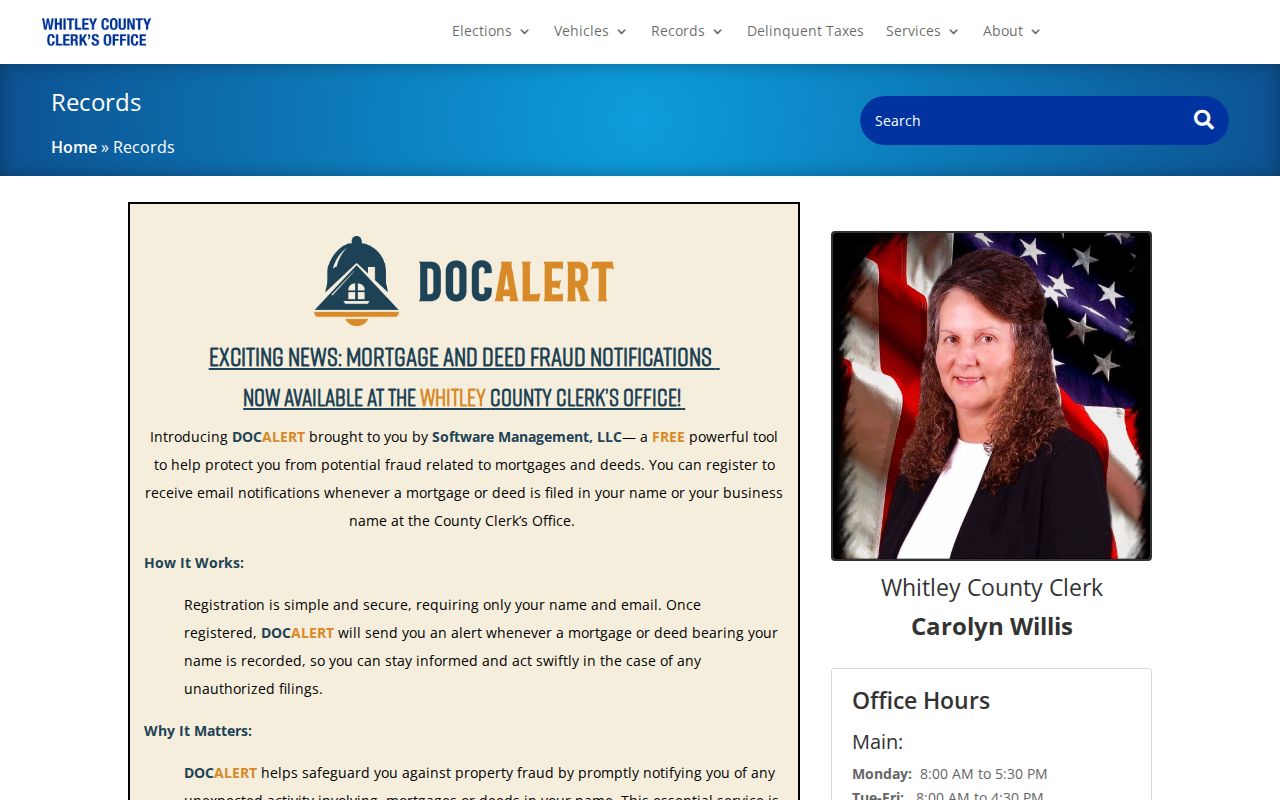
Use the page to confirm the current access route and contact options. Once an index row appears, the recorded image or certified copy supplies the language that matters: named parties, execution and recording dates, legal description, consideration language, and prior reference. Save the source date. Portal access and image coverage can change.
Whitley Names Need a Second Source
Names shift shape along the property trail. A PVA card may list an estate, trust, business, abbreviated owner, or mailing addressee. A deed may spell the grantee differently, and an older index may file a person under initials or a former surname. Search the exact text first. Then try sensible variants. Never merge two people just because their names look alike.
- Grantor
- The party transferring an interest in a recorded instrument.
- Grantee
- The party receiving the recorded interest.
- Parcel
- A tax and map unit identified by the PVA; it may change after a split or combination.
- Plat
- A recorded drawing that can show lots, streets, easements, and dedications.
- Situs address
- The location address of the property, distinct from an owner's mailing address.
For an estate, add the probate case, will, affidavit of descent, executor deed, or later conveyance. For an LLC, the Kentucky Secretary of State search helps identify the entity. The clerk's deed remains the land-transfer record either way.
Williamsburg's Compact Records Route
Williamsburg holds the county seat. Many custodians cluster in its civic core: the County Clerk, PVA, sheriff tax office, Judicial Center, city offices, and public library. That concentration makes a planned records day work well. It helps when an online image or old volume goes missing. Hours differ. Verify each office before you travel, and carry the same parcel identifiers from stop to stop.
The library's genealogy page maps out the local-history route shown in the image below.
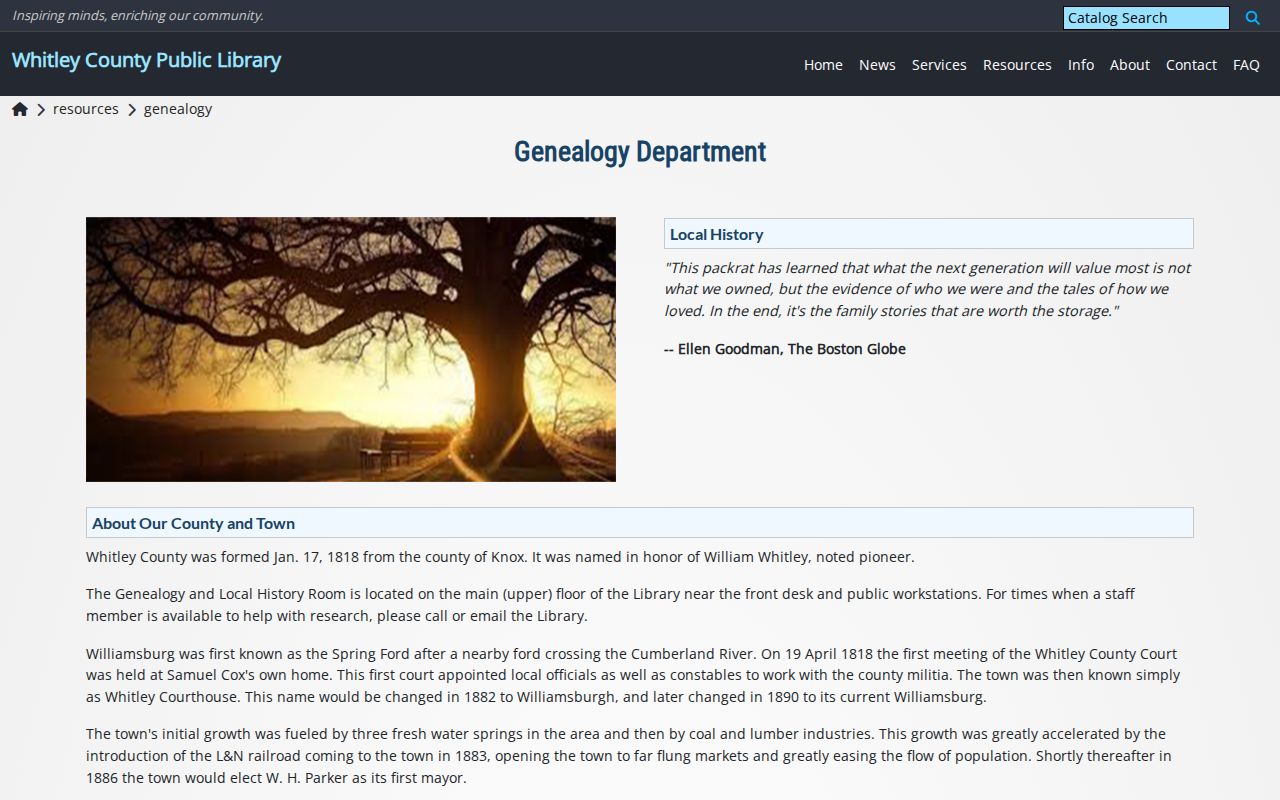
An old newspaper item can hand you a name. An obituary might mention a family business, a court sale, or an old place label that finally cracks the formal index. That clue only counts once it is tied to the parcel through a deed, a plat, a tax record, a probate file, or a court document.
Request Channels for Whitley County Property Records
Portals are not the only door. The County Clerk takes focused open-records requests by hand delivery, mail, fax, or email under its published policy. The recording division can supply deed images that a search misses. Court copies come from the court clerk. Historic volumes sit with the county or KDLA, and municipal permits come from Corbin or Williamsburg.
Give each request real handles. Include the address and the parcel or account number. Add the owner's exact spelling, the document type, and the date range. Note any book, page, or case number you hold. Ask about electronic copies and costs before you order. Kentucky's Open Records Act guarantees access to existing public records subject to exemptions. It does not force an office to build a new parcel history. Nor must it answer a research question for you.
Limits of Whitley County Property Records
Keep an evidence log for any result that will guide a purchase, an estate, a tax appeal, or a boundary dispute. Note the portal or office, the date checked, the search terms, the parcel identifier, the book and page or instrument number, and any access warning. A log like this makes later updates far easier. It also keeps an index entry from being mistaken for the underlying document.
Whitley County property records can pin down an assessed parcel, a tax-roll name, a recorded grantee, a deed description, a lien, a plat, a bill, or a court filing. That is real power. Still, they cannot prove who lives at an address, whether every interest has been found, or whether title is clear. They will not settle where a surveyed line lies either, and they say nothing about what the property would sell for today. Label each claim by its source. Label it by its access date too.
Lawful use. Use Whitley County property records for legitimate property research and civic review. Never use owner information to stalk, harass, threaten, or harm anyone.
Kentucky Safe at Home offers qualifying survivors a substitute address and mail forwarding. State guidance is plain, though: real-estate holdings may stay public. Vital records may be restricted. Sealed court files, protected voter information, and motor-vehicle data each follow their own laws. Access to one record never erases those boundaries.